MLB Betting Guide
Online Betting MLB: Top Odds and UKGC Bookmakers for 2026
 Available in US
Six years ago I placed my first MLB bet from a flat in south London, backing the Dodgers on a Tuesday night moneyline because a mate told me their pitcher was “unreal.” I had no idea what a run line was, couldn’t read American odds to save my life, and treated the whole thing like a coin flip with better scenery. I lost. Then I lost again. Then I started learning.
The global sports betting market stands at roughly £86 billion and is forecast to approach £157 billion by 2030, per ResearchAndMarkets data. Within that landscape, Major League Baseball occupies a peculiar sweet spot for UK punters, as it’s the only major North American league that plays 2,430 regular-season games per year, giving you more data points than the NFL, NBA, and NHL combined. That volume isn’t just trivia. It’s the reason I eventually found my edge.
Regular-Season Games Per Year
2,430 – more than any other major North American league
UK Remote Gambling GGY
£7.8 billion (April 2024 – March 2025), per UK Gambling Commission
US Sports Betting Revenue 2025
£13.4 billion – a record, up 22.8% year-on-year, per the American Gaming Association
This guide covers every bet type available on UK sportsbooks, walks you through reading odds in all three formats, explains why the starting pitcher matters more than any single factor in football, and digs into the integrity questions that most guides in this space ignore entirely. I’ve built it around real market data (UK Gambling Commission reports, MLB revenue figures, the Clase-Ortiz pitch-fixing indictment) because opinions without numbers are just noise.
Whether you’re placing your first baseball wager tonight or refining a system you’ve run for seasons, every section here stands alone, so skip ahead if you already know your way around a moneyline.
Table of Contents
- Analyzing MLB Wagering Trends and Markets in Britain
- Why MLB Attracts UK Punters
- UK Betting Market and MLB’s Place in It
- MLB Bet Types: Moneyline, Run Line, and Totals
- Reading MLB Odds: Decimal, Fractional, and American
- Why the Starting Pitcher Shapes Every MLB Bet
- Live Betting on MLB: What UK Punters Should Know
- MLB Futures and World Series Odds at a Glance
- Player Props: Betting on Individual Performances
- Parlays and Same-Game Parlays in Baseball
- Licensing, Safety, and UKGC Regulation
- Integrity Concerns: From Pitch-Fixing to Prediction Markets
- Bankroll Basics for MLB Wagering
- Frequently Asked Questions
Analyzing MLB Wagering Trends and Markets in Britain
- MLB’s 2,430 regular-season games per year offer UK punters the largest single-sport sample size in North American betting, with more data points than the NFL, NBA, and NHL combined.
- The UK remote gambling sector generated £7.8 billion in GGY for 2024-25, with 8% of UK adults actively betting on sports online. MLB fills the summer gap when football markets thin out.
- Three bet types form the foundation: moneyline (outright winner), run line (1.5-run handicap), and totals (over/under on combined runs). Master these before exploring props, futures, or parlays.
- The starting pitcher is the single most influential variable in any MLB game. Never place a bet without checking the pitching matchup, recent form (ERA, FIP, WHIP), and bullpen depth behind the starter.
- Only bet with UKGC-licensed operators. The Clase-Ortiz pitch-fixing scandal and the emergence of prediction markets make integrity monitoring and consumer protection more critical than ever.
Why MLB Attracts UK Punters
I remember the first time a fellow punter asked me why I’d bother with baseball when there’s a perfectly good Premier League to bet on. Fair question. Football is king in the UK, with roughly 6% of the adult population placing football bets, per Gambling Commission data. But that dominance is exactly the problem if you’re looking for value. The Premier League market is so heavily bet, so deeply analysed by sharps and algorithms, that finding a mispriced line feels like finding a tenner on Oxford Street. MLB, by contrast, is a relative backwater on UK platforms, and backwaters are where edges survive.
The sheer volume helps. Each of the 30 MLB teams plays 162 games in a regular season, producing 2,430 games between late March and early October. Compare that to the NFL’s 272 regular-season games or the Premier League’s 380. More games mean more opportunities to test a thesis, more chances to recover from variance, and more data to build a model around.
MLB attendance hit 71,409,421 in the 2025 season, the third consecutive year above 70 million and the first three-year growth streak since 2007, per MLB’s official figures.

The league’s commercial health reinforces the opportunity. MLB logged a record £9.6 billion in revenue for 2024, surpassing the previous high of £9.2 billion. That financial muscle translates into broadcast deals, digital infrastructure, and data transparency that directly benefit UK punters. You can watch the games you’re betting on, even at half-eleven on a Tuesday night. MLB.TV viewership reached 19.39 billion minutes in 2025, a 34% increase year-on-year, with the 18-34 demographic surging across every major network.
Then there’s the pace. The pitch clock trimmed the average nine-inning game to 2 hours 38 minutes in 2025, the third consecutive season below 2:40, something the sport hadn’t achieved since 1983-85. Only three nine-inning games exceeded 3 hours 30 minutes all year, compared to 391 in 2021. For someone betting from the UK, a tighter game fits neatly into an evening.
UK Betting Market and MLB’s Place in It
A punter I mentor once told me he assumed MLB betting was a niche within a niche, a tiny corner of the UK market that barely registers. He was right about the scale, wrong about the implication. The UK’s remote gambling sector (casino, betting, and bingo combined) generated £7.8 billion in Gross Gambling Yield for the year ending March 2025, a 13.1% increase on the prior period, per the UK Gambling Commission’s annual industry report. Online betting on real-world sporting events alone brought in £596 million in Q4 of that reporting year, up 5% year-on-year. The market is enormous, liquid, and regulated to a degree that most international bettors can only envy.
Online Sports Betting GGY (Q4 2024-25)
£596 million, up 5%
Online Sports Bettors
8% of UK adults in the last 4 weeks (July-October 2025)
Active Online Accounts (Major Operators)
13.5 million monthly average in Q4 2024-25, up 2%

Participation figures tell their own story. The Gambling Commission’s GSGB Wave 3 survey, covering July to October 2025, found that 48% of UK adults had engaged in some form of gambling in the previous four weeks. Strip out the National Lottery and the figure drops to 27%. Online sports betting specifically? That’s 8% of the adult population, a substantial pool of active punters feeding liquidity into markets every week.
The demographic breakdown matters for understanding MLB’s opportunity. Men are roughly four times more likely to bet on sports than women (15% versus 4%, per Q1 2025 data). The 18-24 age group leads in mobile usage (76% of their online gambling on phones), and 95% of all online gambling happens at home. That last point is crucial for MLB, where games air in the evening UK time, in exactly the environment where mobile sportsbook apps thrive.
Football dominates the UK sports betting landscape, and probably always will. But MLB sits in an interesting structural gap: the baseball season runs from late March to October, overlapping with the quieter months of the football calendar. UK bookmakers fill that void with American sports coverage, and licensed operators are increasingly building out MLB market depth. Preliminary betting and gaming tax receipts for April to August 2025/26 reached £1,786 million, up 9% on the same period, per GOV.UK data, a revenue stream that gives the Treasury a direct interest in maintaining this well-regulated market.
MLB Bet Types: Moneyline, Run Line, and Totals
Every MLB wager I’ve ever placed falls into one of three buckets, or a combination of them. Baseball betting revolves around who wins outright, by how much, and how many runs are scored. Master these three and everything else (futures, props, parlays) is built on top of them.
Moneyline – a bet on which team will win the game outright, with no points spread. The simplest wager in baseball.
Run line – baseball’s version of a handicap or point spread. The standard run line is 1.5 runs, meaning the favourite must win by 2 or more runs to cover.
Totals (over/under) – a bet on whether the combined runs scored by both teams will finish above or below a line set by the bookmaker, typically ranging from 7 to 12.
What makes MLB distinct from football is the centrality of the moneyline. In the Premier League, most bets go on the point spread or the 1X2 market. In baseball, the moneyline is the default. That structural difference changes how you think about value, pricing, and risk – and it’s the reason I’d recommend any UK punter new to baseball start here before exploring anything else.
Moneyline Bets
A moneyline bet asks a single question: which team wins? No margin, no spread, no complications. If you back a side at decimal odds of 1.65 and they win by one run in the fourteenth inning, you collect exactly the same as if they’d won 12-0. That simplicity is deceptive, though. Because there’s no spread to equalise the two sides, the odds do all the work, and understanding how those odds are priced is where the real skill lies.
Suppose the away side is listed at 2.40 and the home side at 1.58. Those prices imply the home team wins roughly 63% of the time (1 divided by 1.58), while the away team wins about 42% (1 divided by 2.40). The gap above 100% is the overround, the bookmaker’s margin. In the US market, the average hold rate was 10.15% in 2025, per RG.org data. UK margins on MLB tend to be comparable.
| Format | Away Team | Home Team |
|---|---|---|
| Decimal | 2.40 | 1.58 |
| Fractional | 7/5 | 29/50 |
| American | +140 | -172 |
The moneyline rewards patience and selectivity. I’ve found that the best value often sits with underdogs in the +130 to +180 range (roughly 2.30 to 2.80 decimal), teams getting less than 40% of public money but whose starting pitcher matchup gives them a better chance than the market implies. You’ll lose more bets than you win, but the higher payouts compensate over the 2,430-game sample.
Run Line (Handicap) Bets
If you’ve ever placed a handicap bet on a Premier League match, the run line will feel familiar. The standard MLB run line is -1.5 for the favourite and +1.5 for the underdog. Back the favourite at -1.5 and they need to win by at least two runs. Take the underdog at +1.5 and they just need to avoid losing by two or more – even a one-run defeat gives you a winner.
The 1.5-run line is fixed by convention, not by the bookmaker’s analysis of each game. What changes is the price. A heavy favourite might be -1.5 at 1.55 (barely above evens), while a closely matched game could see -1.5 priced at 2.10 or higher. That pricing difference is where the run line becomes a genuine strategic tool, not just a variant of the moneyline.
I use run lines most often when there’s a clear pitching mismatch. If a top-tier starter faces a bottom-third rotation arm, the favourite is likely to win, but the moneyline price is often squeezed below 1.50, which offers thin value. The run line at -1.5 pushes the odds up to a more interesting range while still reflecting the probable outcome. It’s a trade-off: higher variance for a better price.
Totals (Over/Under)
Totals betting removes the question of who wins entirely. Instead, you’re wagering on whether the combined run total will finish over or under a number set by the bookmaker. In MLB, that line typically sits between 7 and 12 runs, with most games centred around 8 to 9.5. The pricing on each side usually starts close to even, something like 1.91 on both the over and the under, and shifts as money comes in.
What makes totals interesting in baseball is how many variables feed into the number. Starting pitcher quality is the biggest single factor, but park dimensions, weather conditions, altitude (Coors Field in Denver is the obvious outlier), bullpen depth, and lineup construction all matter. A game between two elite starters at a pitcher-friendly park might be posted at 6.5. Two struggling arms at a hitter-friendly venue could see 10.5 or higher. That range gives you plenty of room to find spots where the posted line doesn’t match your assessment.
I tend to bet totals when I have a strong view on the pitching matchup but no strong opinion on who wins. If both starters have been dominant over their last five outings and the park suppresses offence, the under becomes attractive regardless of which side covers the moneyline.
Reading MLB Odds: Decimal, Fractional, and American
The first time I opened an American sportsbook feed and saw -155 next to a team name, I stared at it like it was written in Cyrillic. UK punters grow up with fractional odds – 5/1, 11/8, evens – and most domestic sportsbooks default to decimal. American odds use a completely different logic, and since MLB coverage on UK platforms often inherits its pricing notation from US-origin data feeds, you’ll encounter all three formats sooner or later.
Decimal odds are the simplest to work with. The number represents your total return per pound staked, including the original stake. Odds of 2.50 mean a £10 bet returns £25 (£15 profit plus your £10 back). Fractional odds express only the profit relative to the stake: 3/2 means £3 profit for every £2 staked, which is the same as decimal 2.50. The conversion is straightforward: divide the top number by the bottom and add 1.
| Decimal | Fractional | American | Implied Probability |
|---|---|---|---|
| 1.50 | 1/2 | -200 | 66.7% |
| 1.91 | 91/100 | -110 | 52.4% |
| 2.00 | 1/1 (evens) | +100 | 50.0% |
| 2.50 | 3/2 | +150 | 40.0% |
| 3.50 | 5/2 | +250 | 28.6% |
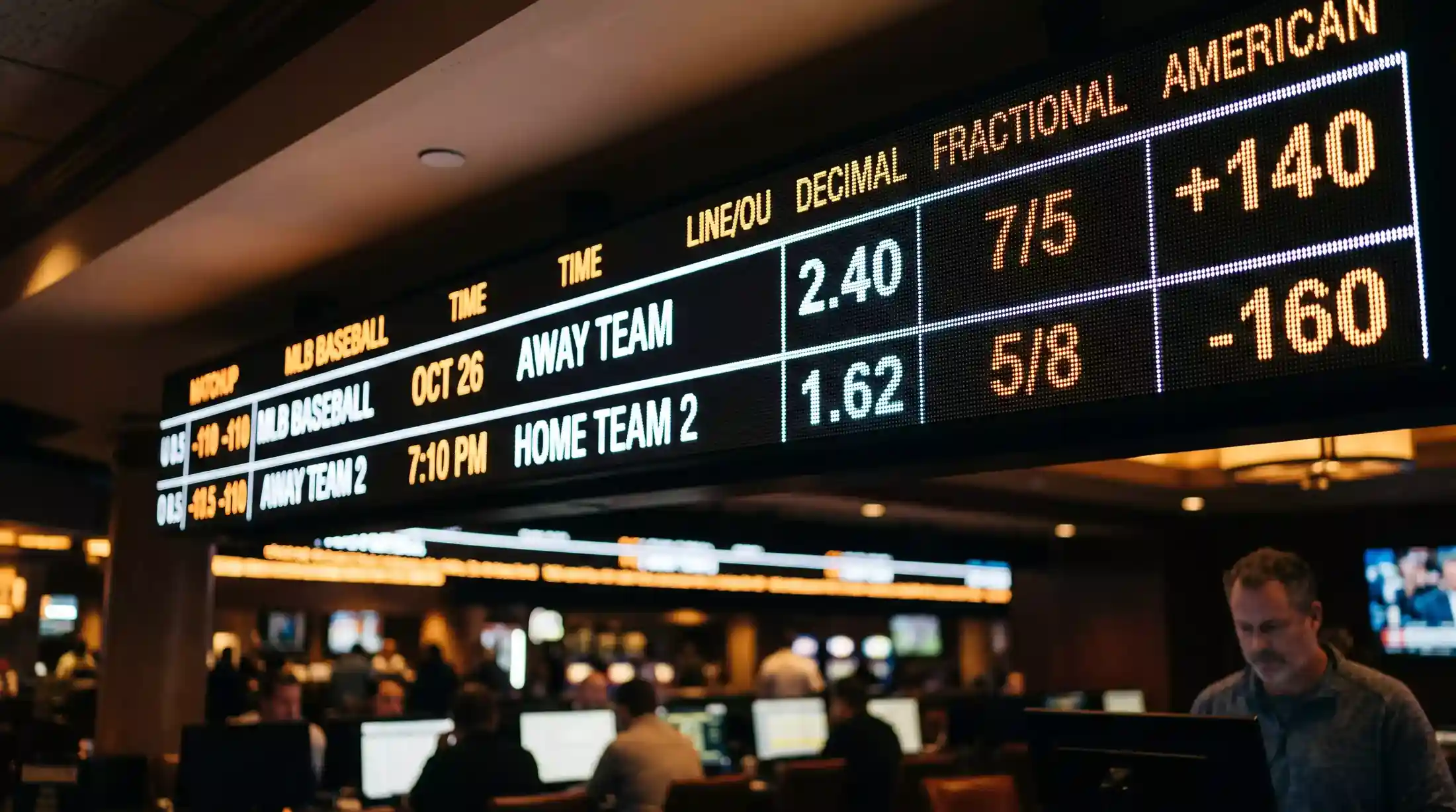
American odds are where UK punters typically stumble. A negative number (-155) tells you how much you’d need to stake to win £100 (or £100; the currency doesn’t change the maths). So -155 means risking £155 to win £100 in profit. A positive number (+140) tells you how much profit a £100 stake would generate, meaning £140 profit on a £100 bet. The minus sign marks the favourite; the plus sign marks the underdog.
To convert American odds to decimal: for negatives, divide 100 by the number (ignoring the minus sign) and add 1. So -155 becomes (100 / 155) + 1 = 1.645. For positives, divide the number by 100 and add 1. So +140 becomes (140 / 100) + 1 = 2.40. Once you’ve done this a few dozen times, the pattern becomes second nature.
Implied probability is the concept that ties all three formats together. It’s the market’s estimate of how likely an outcome is, embedded in the price. To extract it from decimal odds, divide 1 by the odds: 1 / 1.645 = 0.608, or roughly 60.8%. The reason this matters is that you’re not just betting on who wins; you’re betting on whether the true probability is higher than the implied probability. That gap, if you can identify it consistently, is your edge. Most UK sportsbooks let you toggle between formats in your account settings, but I’d encourage you to learn the American format. The sharpest MLB analysis is almost always reported in American odds.
Why the Starting Pitcher Shapes Every MLB Bet
I once watched a punter bet a full slate of twelve MLB games in fifteen minutes, choosing sides based on team records alone. He went 4-8 on the night. When I looked at his selections, every single loss had the weaker starting pitcher on the mound. He hadn’t checked a single one. That story captures something fundamental about baseball betting: the starting pitcher is the single most influential variable in any game, and ignoring this is the fastest way to burn through a bankroll.
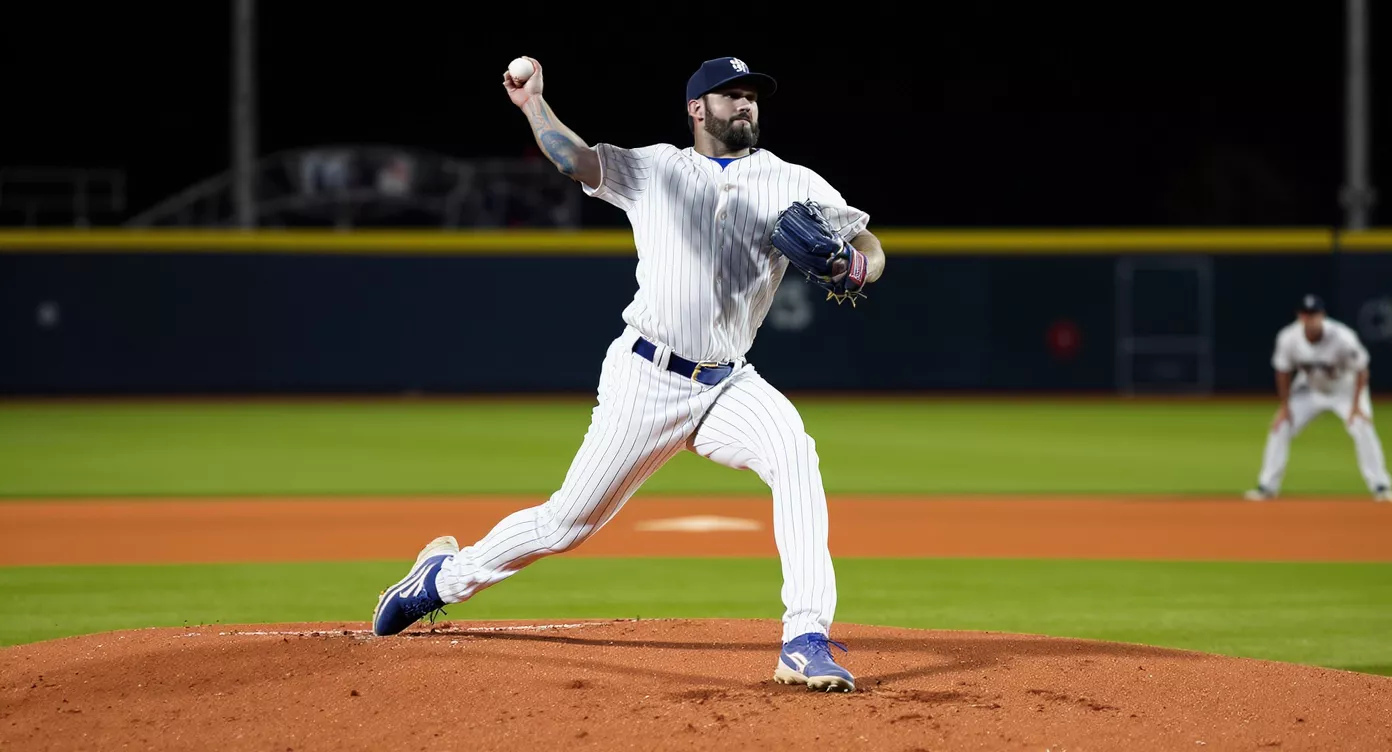
In football, no one player controls the match the way a starting pitcher controls a baseball game. The starter typically faces the opposing lineup three times through the order – roughly five to seven innings, or 60 to 100 pitches, and their performance dictates run-scoring on both sides. The game’s outcome often hinges on whether the starter survives into the sixth inning or gets pulled after four.
ERA (Earned Run Average) – the average number of earned runs a pitcher allows per nine innings. A useful starting point, but heavily influenced by defence, park factors, and luck on balls in play. WHIP (Walks plus Hits per Inning Pitched) – measures how many baserunners a pitcher allows per inning. Lower is better. A WHIP below 1.10 signals elite control; above 1.40 suggests trouble. FIP (Fielding Independent Pitching) – isolates the outcomes a pitcher controls directly: strikeouts, walks, hit-by-pitches, and home runs. FIP strips out defence and luck, making it a sharper predictor of future performance than ERA.
MLB Commissioner Rob Manfred has stated that the ability to monitor betting activity and discern inappropriate patterns is “really, really important,” and that monitoring starts with the players most capable of influencing outcomes. Starting pitchers sit at the top of that list. When a starter’s ERA says 3.20 but his FIP says 4.50, the gap tells you he’s been lucky. The ERA will likely regress toward the FIP over time, and the betting market won’t always price that regression quickly enough.
Pre-Match Pitcher Assessment
- Check the starter’s ERA, FIP, and WHIP over the last 30 days – recent form matters more than season averages in a 162-game grind
- Review his pitch count and rest days – a starter on short rest after a high-pitch outing is a red flag
- Look at the matchup history against the opposing lineup – some batters crush left-handed pitching, others struggle against high-velocity fastballs
- Assess bullpen depth behind him – a starter likely to exit after five innings hands the game to the relief corps, and bullpen quality varies wildly across MLB
- Factor in park and weather conditions – wind blowing out at Wrigley Field amplifies offence regardless of who’s pitching
The checklist above is a compressed version of what I run through before every wager. It takes about ten minutes per game once you know where to find the data (FanGraphs and Baseball Savant are the standard free sources), and it eliminates a huge class of bad bets. If you only adopt one analytical habit from this guide, make it this: never place an MLB bet without knowing who’s starting on the mound.
Live Betting on MLB: What UK Punters Should Know
The first live MLB bet I ever placed was a disaster. I backed the over on the game total in the fourth inning because both teams had already scored five runs, thinking the floodgates were open. The bullpens came in, slammed the door, and the final score was 6-5. I learned something important that night: live betting rewards quick thinking, but it punishes impulsive thinking even faster.
Live and in-play wagers accounted for 62.35% of all online sports betting revenue in 2025, per industry research compiled by Precedence Research. In-play isn’t a niche feature; it’s the majority of the market.
MLB’s structure makes it unusually well-suited to live betting. The game unfolds in discrete, countable units – pitches, at-bats, half-innings, innings – and each unit generates new information that shifts probabilities. A starting pitcher who looks sharp through three innings might suddenly lose command in the fourth, loading the bases with nobody out. That moment is a pricing event. The live odds will adjust, but they won’t adjust instantly or perfectly, and that gap is where prepared bettors find value.
The pitch clock has compressed the pace of play, with games averaging 2 hours 38 minutes in 2025. That compression creates both opportunities and challenges for live bettors: faster innings mean the odds move more frequently, generating more entry points, but you have less time to evaluate each shift before the next pitch is thrown. For UK punters sitting at home in the evening, the tempo is brisk but manageable if you’ve done your pre-game homework on the starting pitchers and bullpens.
The markets available in-play on UK platforms typically include next-inning winner, next-inning total runs, updated moneyline, updated run line, and updated game total. Some operators also offer at-bat level markets, though these have come under scrutiny following recent integrity concerns. I’d recommend starting with inning-level markets – the decision window is wider, and the data is easier to process in real time. For a deeper look at timing entries around bullpen changes, see the dedicated piece on in-play MLB betting strategy.
Live betting captures the game in motion, but some of the most interesting MLB markets don’t start until months before the first pitch is thrown.
MLB Futures and World Series Odds at a Glance
There’s a specific kind of thrill in placing a futures bet in February and watching it gain value through July. I backed a division winner two seasons ago at 14.00, and by mid-season the same bet was trading at 3.50. I didn’t even need them to win it; the value had already materialised, and I could have hedged for a guaranteed return. That long-horizon dynamic is what separates futures from game-to-game wagering.
MLB futures markets include World Series winner, American League and National League pennant winners, division winners (six divisions), individual award winners (MVP, Cy Young, Rookie of the Year), and season win totals. These markets typically open in the off-season and remain active until the outcome is decided, with prices adjusting continuously as the season unfolds.
The pricing logic behind MLB futures reflects a league where £9.6 billion in annual revenue supports 30 franchises of vastly different financial weight. The Yankees and Dodgers, the only two clubs generating more than £475 million in individual revenue during the 2024 season, tend to carry shorter futures odds because they can afford the deepest rosters. But talent doesn’t always correlate with payroll in a sport where a 21-year-old arm can reshape a rotation overnight, and that disconnect is where futures value tends to hide.
Season win totals are the futures market I find most analytically tractable. Each team has a posted number, say, 85.5 wins, and you bet the over or the under. If your model projects a team to 89 wins against a posted 85.5, that three-and-a-half-win gap represents significant expected value. The challenge is building a model that accounts for rotation depth, bullpen quality, and injury risk, but the futures market rewards that effort more than any single-game bet can.
Futures zoom out to the full season, but the market’s most granular bets zoom in on individual players within a single game.
Player Props: Betting on Individual Performances
Most punters start with team-level bets (moneylines, run lines, totals) and that’s sensible. But once you’ve built some analytical confidence, player props open up a completely different dimension. Instead of asking “will the Yankees win?”, you’re asking “will this specific pitcher record seven or more strikeouts?” or “will this batter get two or more hits?” The question is narrower, the analysis is more focused, and the edges can be sharper precisely because fewer people are studying these lines as closely.
Strikeout prop – a bet on whether a pitcher will record more or fewer strikeouts than a line set by the bookmaker, typically ranging from 4.5 to 8.5 for starters.
Home run prop – a bet on whether a specific batter will hit at least one home run in the game. Often priced as a “yes/no” market with the “yes” carrying odds of 3.50 or higher.
The prop market, however, carries a recent shadow. In November 2025, Cleveland Guardians pitchers Emmanuel Clase and Luis Ortiz were charged under a federal indictment for allegedly manipulating pitches to benefit bettors – a scheme that reportedly generated at least £315,000 for the betting ring. The fallout was swift: MLB and its sportsbook partners capped micro-prop bets (wagers on individual pitches) at £160 and excluded them from parlays. That restriction directly affects the prop landscape available on UK platforms, and it’s a reminder that the granularity of prop betting creates integrity vulnerabilities that team-level markets largely avoid.
For UK punters, the prop markets most readily available on licensed platforms tend to be pitcher strikeouts, batter hits, total bases, and home runs. I’d recommend focusing on pitcher strikeouts, where the predictive stats (swinging-strike rate, K/9, opponent chase rate) are the most reliable. A deeper breakdown of analysis methods and post-scandal restrictions is available in the player props guide.
Props isolate individual performances – but the market that combines them into a single ticket introduces both higher potential returns and significantly more risk.
Parlays and Same-Game Parlays in Baseball
Parlays are where discipline goes to die, and I say that as someone who has built more than a few ill-advised four-leggers on a Saturday afternoon. The appeal is obvious: chain together three or four selections, and a modest stake can return a significant payout. The maths is equally obvious: each additional leg multiplies the probability of losing. A three-leg parlay where each individual bet has a 55% chance of winning has a combined probability of just 16.6%. Those odds are brutal, and the bookmaker’s margin on each leg compounds the disadvantage.
Parlays carry significantly higher effective margins than single bets. Each leg’s overround compounds, meaning the bookmaker’s built-in edge grows with every selection you add. Treat parlays as entertainment with a small portion of your bankroll – never as the core of a staking strategy.
Same-game parlays (SGPs) – called “bet builders” on some UK platforms – add another layer of complexity. An SGP combines multiple selections from within a single game: the home team moneyline, the over on the game total, and a batter to hit a home run. The problem is correlation. If the home team wins by a big margin, the game total is more likely to go over, and individual batters on the winning side are more likely to post strong stat lines. Bookmakers adjust for this, but their adjustments tend to favour the house.
I won’t pretend I never place parlays. I do, occasionally, when I have three genuinely independent views. But I cap my parlay stake at 1-2% of my bankroll, never go beyond three legs, and never include a selection I wouldn’t back as a single. If parlays are going to be part of your approach, understanding the correlation pricing is essential before you start building tickets.
Licensing, Safety, and UKGC Regulation
I’ve had exactly one experience with an unlicensed offshore sportsbook, and it ended predictably: a withdrawal request that went unanswered for six weeks, followed by an email explaining that my account had been “flagged for review.” I never saw the money. That was early in my betting life, and it taught me a lesson I haven’t forgotten: the regulatory framework around your sportsbook matters as much as the odds on your screen.
The UK Gambling Commission (UKGC) operates under the Gambling Act 2005, which requires any operator offering gambling services to UK consumers to hold a valid remote licence. This isn’t a rubber stamp. Licensed operators must segregate customer funds, submit to regular audits, implement responsible gambling tools, and report suspicious betting activity to integrity bodies. The online sector continues to grow even as physical premises decline – licensed gambling premises fell 1.1% to 8,234 and licensed betting shops dropped 1.8% to 5,825 in the latest reporting period, reflecting the broader shift toward digital.
The Credit Card Ban: Since April 2020, UK consumers have been prohibited from using credit cards for online gambling transactions. This applies to all UKGC-licensed operators without exception. You can fund your account via debit card, bank transfer, or approved e-wallets. GamStop: The national self-exclusion scheme allows you to block yourself from all UKGC-licensed online gambling sites for a minimum of six months. Once activated, no licensed operator can accept your bets until the exclusion period ends and you actively choose to re-register.
Bryan Seeley, MLB’s EVP of Legal and Operations, has argued that as prediction market contracts increasingly resemble traditional sports betting, the need to replicate integrity and consumer protections grows more pressing. That concern applies equally to the UK context – the UKGC’s licensing regime provides dispute resolution, fund segregation, mandatory cooling-off periods, and reality-check prompts that offshore platforms simply cannot match.
For MLB betting, the practical implication is straightforward: only bet with operators that hold a UKGC remote licence. You can verify any operator’s licence status on the Gambling Commission’s public register.
Integrity Concerns: From Pitch-Fixing to Prediction Markets
If you’d told me five years ago that MLB pitchers would face federal charges for deliberately throwing wild pitches to influence prop bets, I’d have laughed. Nobody’s laughing now. The Clase-Ortiz indictment in November 2025 wasn’t just a scandal; it was a structural warning about what happens when betting markets get granular enough to target individual actions within a game.
The Clase-Ortiz case centred on micro-prop manipulation – deliberate wild pitches and passed balls designed to trigger specific bet outcomes. The scheme reportedly generated at least £315,000 for the betting ring involved. MLB and its sportsbook partners responded by capping micro-prop bets at £160 and excluding single-pitch wagers from parlays.

The fallout extended well beyond the two players. Senators Ted Cruz and Maria Cantwell, writing from the US Senate Commerce Committee, described the situation in stark terms: what might have been dismissed as an isolated incident of game rigging instead pointed to a deeper, systemic vulnerability emerging across multiple leagues. That assessment carries weight because it suggests the regulatory response is far from over. Congressional hearings, tighter prop bet restrictions, and expanded integrity monitoring are all on the table.
MLB Commissioner Rob Manfred has been characteristically direct: the bedrock of MLB’s relationship with sportsbooks is the ability to monitor betting activity and discern inappropriate patterns. That monitoring depends on data-sharing agreements with licensed operators – agreements that offshore and unregulated platforms don’t participate in.
Jason Van’t Hof, formerly VP of Investigations at integrity monitoring firm IC360, described the current moment as a watershed, arguing that the indictments and congressional attention would prompt leagues to take further action. The micro-prop caps are an early example. More structural changes to the types of bets available are likely as the industry recalibrates the balance between market innovation and integrity risk.
Prediction Markets and MLB: In March 2026, Polymarket became an official MLB prediction market partner, gaining exclusive access to Sportradar data under an integrity framework that prohibits contracts on individual pitches and managerial decisions. The American Gaming Association estimates prediction markets have diverted more than £395 million in potential tax revenue from regulated sportsbooks – a figure that explains MLB’s decision to bring these platforms inside the tent rather than leave them outside it.
Public sentiment is shifting, too. Pew Research data from October 2025 found that 43% of American adults believe legalised sports betting is bad for society, up from 34% in 2022. That shift creates political pressure for tighter regulation – pressure that will eventually affect the range of markets available to UK punters on UKGC-licensed platforms.
None of this means you should avoid MLB betting. It means you should bet with your eyes open. The integrity infrastructure is being strengthened, micro-prop restrictions have reduced the most vulnerable market segments, and the UKGC adds a further layer of protection. But the Clase-Ortiz case is a reminder that even America’s pastime isn’t above the risks that come with a £13.4 billion annual handle.
Bankroll Basics for MLB Wagering
Here’s a confession: my first two MLB seasons were profitable on paper and disastrous in practice. I was picking winners at a decent clip but staking erratically – £50 on a game I loved, £10 on one I wasn’t sure about, £100 on a “can’t lose” parlay that lost. By September I’d given back most of my gains through a handful of oversized bets that went wrong. The analysis was fine. The bankroll management was non-existent.
The simplest framework that actually works is unit-based staking. Decide on a total bankroll – the amount you can afford to lose entirely without affecting your life – and divide it into units, typically 50 to 100. If your bankroll is £2,000 and you use 100 units, each unit is £20. Every standard bet is one unit. A strong-conviction play might justify two units. Three units should be exceptionally rare, and anything above that is gambling with your emotions rather than your analysis.
Bankroll Discipline Checklist
- Set a total bankroll before the season starts and don’t add to it mid-season to chase losses
- Define your standard unit size at 1-2% of your total bankroll
- Never stake more than 3% of your current bankroll on a single game, regardless of how confident you feel
- Track every bet in a spreadsheet – date, game, bet type, odds, stake, result – and review weekly
- Accept that losing streaks of 8-12 bets are normal in MLB and do not indicate a broken strategy
MLB’s 162-game schedule is both a blessing and a trap for bankroll management. The blessing: a large sample size smooths out variance. The trap: the daily volume tempts you into over-betting. There are days with fifteen games on the slate, and the urge to have action on all of them is real. I’ve learned to cap myself at three to five bets per day, chosen through my full analytical process.
Bankroll management isn’t about restricting yourself – it’s about surviving long enough for your analysis to pay off. A 5% edge at the correct unit size will make you money over 500 bets. That same edge, staked at 10% of your bankroll per game, will likely bankrupt you before it has a chance to express itself. Size your bets for the marathon.
MLB Betting Analyst – Specialising in run-line value, pitcher-driven handicapping, and statistical modelling across Major League Baseball markets
Frequently Asked Questions
How does MLB betting work for UK punters?
MLB betting works through UKGC-licensed sportsbooks that offer markets on Major League Baseball games. You select a bet type – moneyline, run line, totals, futures, or player props – choose your stake, and place the wager. Games typically start between 11 PM and 1 AM BST for evening fixtures, with earlier starts on weekends. UK operators display odds in decimal or fractional format by default, though American odds are usually available in your account settings.
What is a run line bet in baseball?
A run line is baseball’s equivalent of a handicap or point spread, set at 1.5 runs. The favourite at -1.5 must win by at least two runs; the underdog at +1.5 can lose by one run and the bet still wins. The spread is fixed – what changes is the price attached to each side. Alternative run lines at -2.5, +2.5, and other intervals are available on most UK platforms.
Which UK bookmakers offer MLB odds?
Most major UKGC-licensed sportsbooks carry MLB markets during the regular season and postseason. Market depth varies – some offer extensive prop bets and alternative lines, while others stick to moneyline, run line, and totals. You can verify any operator’s licence status on the Gambling Commission’s public register.
Can I bet on MLB games live (in-play)?
Yes. In-play betting on MLB is widely available through UK-licensed platforms. Live markets typically include updated moneyline, run line, and game totals, along with inning-specific markets. Some operators offer at-bat-level markets, though micro-prop availability has been reduced following recent integrity concerns. The pitch clock’s compression of game pace to an average of 2 hours 38 minutes makes live MLB betting fast-moving.
How do I read American odds as a UK bettor?
A negative number (e.g. -150) tells you how much you’d stake to win £100 profit, so -150 means risking £150 to win £100. A positive number (e.g. +130) tells you the profit on a £100 stake – £130 profit. To convert to decimal: for negatives, divide 100 by the number and add 1 (-150 becomes 1.67); for positives, divide by 100 and add 1 (+130 becomes 2.30). Most UK sportsbooks let you toggle to decimal or fractional display.
Are MLB betting sites safe and UKGC-licensed?
Any sportsbook offering MLB betting to UK customers must hold a remote licence from the UK Gambling Commission. Licensed operators segregate customer funds, implement responsible gambling tools (deposit limits, GamStop self-exclusion), and comply with the credit card gambling ban. Offshore sites without UKGC approval do not provide these protections.
What types of bets can I place on MLB games?
Main bet types on UK platforms include moneyline (picking the winner), run line (1.5-run handicap), totals (over/under on combined runs), futures (World Series, division winners, MVP), player props (strikeouts, home runs), parlays, same-game parlays, and first-five-innings bets. Market depth varies by operator and game profile.
Created by the ”Online Betting mlb” editorial team.